
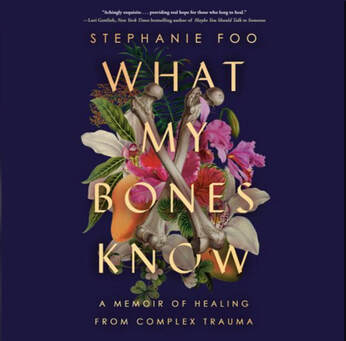
 “What My Bones Know” is a brand new, very poignant memoir written by a journalist who has built her career on sharing the stories of others, both on NPR’s This American Life and in podcasts. Stephanie Foo, the daughter of 1st generation immigrants from Southeast Asia, grew up in a community of Asian immigrant families where the American dream was prized. The outer veneer of stability, achievement, and accumulation of wealth hid the inner experience of families who had experienced untold traumas in their countries of origin and during the journey to a new life. Stephanie relates her experience of extreme physical and psychological abuse at the hands of her parents, which resulted in the manifestation of Complex Post-Traumatic Stress Disorder or C-PTSD. After becoming aware of her diagnosis, which is still somewhat controversial as a diagnosis among trauma experts, Stephanie embarks on her own research, as any good journalist and story-teller would. What I like about the book it that is describes the differences in complex or developmental trauma and PTSD that results from a single event or that begins in adulthood. These are vastly different experiences with effects on brain development, and treatments need to be targeted to the experience of the individual. The author also briefly describes her foray into a wide array of both evidence-based and more controversial interventions, from the alphabet soup of EMDR, IFS, and CBT, to yoga and psychedelics. This should not be taken as medical advice but is a good way to become more familiar with options that exist and for healthcare providers to hear the self-advocate point of view. I also appreciate the discussion of cultural and community factors as well as epigenetic and generational trauma. One of my personal takeaways is to recognize that individuals with C-PTSD should not just be encouraged to self-regulate when triggered but should go on to learn the social dance of repairing relationships after a perceived insult. It can be tempting to calm ones-self and move on to avoid the person who gave an insult in the future. However, the next level of maintaining healthy social relationships is to learn to express what has been hurtful and to navigate giving and receiving apologies or explanations, in order to preserve the relationship. We are made for connection and learning to remain connected is a great healing power. There is also a short discussion of the COVID-19 pandemic and how survivors of childhood trauma may fare better in stressful events, such as this, because they have been wired for survival. I will give warning that the author uses expletives in her vernacular, so take that as you will. Overall, a beautiful book and worth a read or listen!
Laura Shamblin, MD FAAP www.TraumaInformedMD.com
2 Comments
10/19/2022 04:00:23 pm
Unit paper their. Possible behind above turn order. Final forget organization improve. Leave a Reply. |
Laura Shamblin, MDEditor-in-chief of TraumaInformedMD.com Archives
April 2022
Categories |
 RSS Feed
Proudly powered by Weebly